

Insecticides are one of the main tools used to control mosquitoes that spread malaria. However, over time, mosquitoes can adapt and become resistant, which makes these insecticides less effective. This growing resistance is a serious challenge for public health and reduces the impact of malaria control efforts.
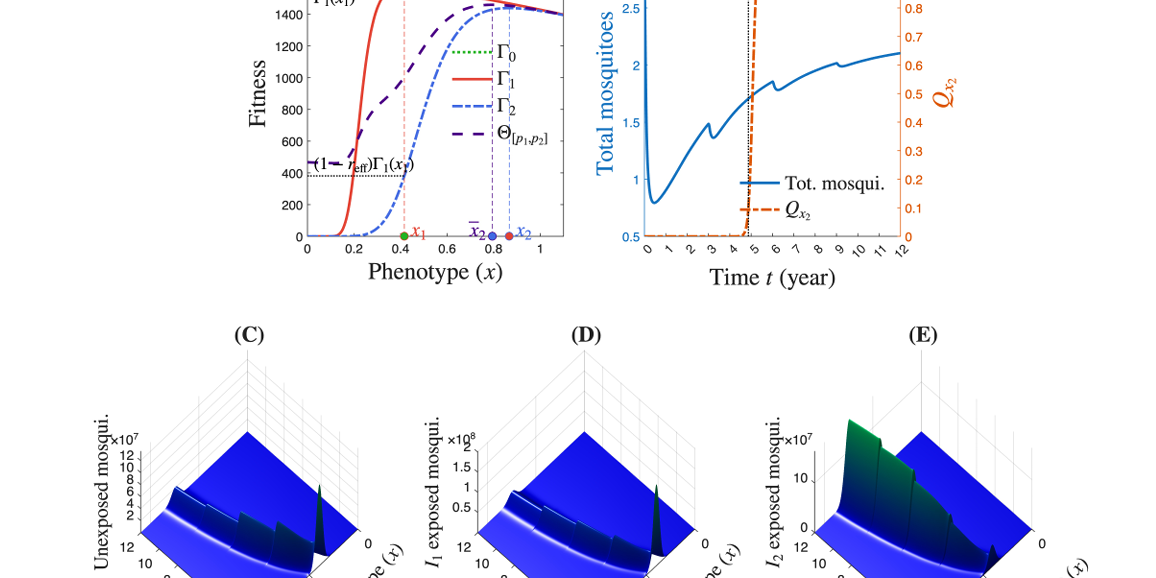
In this study, Sylvère Kezeta – Bondja, Ph. D student at the University of Yaoundé I explored how insecticides can be used more strategically to slow down the development of resistance. To do this, he created a mathematical model, which is a type of simulation that helps predict how mosquito populations respond to different insecticide use strategies over time. The model compares two insecticides that work in similar ways but are not equally effective, while also taking into account how mosquitoes gradually develop resistance.
Key Findings
The results show that the best strategy depends on how quickly mosquitoes are able to adapt. When resistance develops very quickly, the most effective approach is to use the strongest insecticide at full coverage from the beginning. In this situation, acting immediately and with maximum strength gives the best results, because delaying or reducing use would allow resistance to spread even faster.
On the other hand, when mosquitoes develop resistance more slowly, a more gradual strategy works better. Instead of using insecticides at full strength right away, it is more effective to start with lower levels and then increase their use over time. This approach helps delay resistance and makes the insecticide remain useful for longer.
Implications for Vector Control
The study also examined whether it is better to use two insecticides at the same time or one after the other. Interestingly, the results show that using both simultaneously is often not the best option. Instead, a sequential approach works better: one insecticide is used until it begins to lose its effectiveness, and then it is replaced with another. This strategy helps delay resistance and maintains better mosquito control over the long term.
Overall, this research highlights the importance of using insecticides in a smarter and more planned way. Rather than relying only on the chemicals themselves, adapting how and when they are used can significantly improve their long-term effectiveness. These findings can support malaria control programs by helping them reduce resistance, protect communities more effectively, and extend the usefulness of available tools.
The study, conducted as part of the ACoMVeC project, was led by Sylvère Kézéta-Bondja, a PhD student. It was published in Springer Nature Link’s Journal of Mathematical Biology. Read more: https://doi.org/10.1007/s00285-026-02343-z