
This was on Friday, May 22, 2026, at the Faculty of Science of the University of Yaoundé I (UYI).
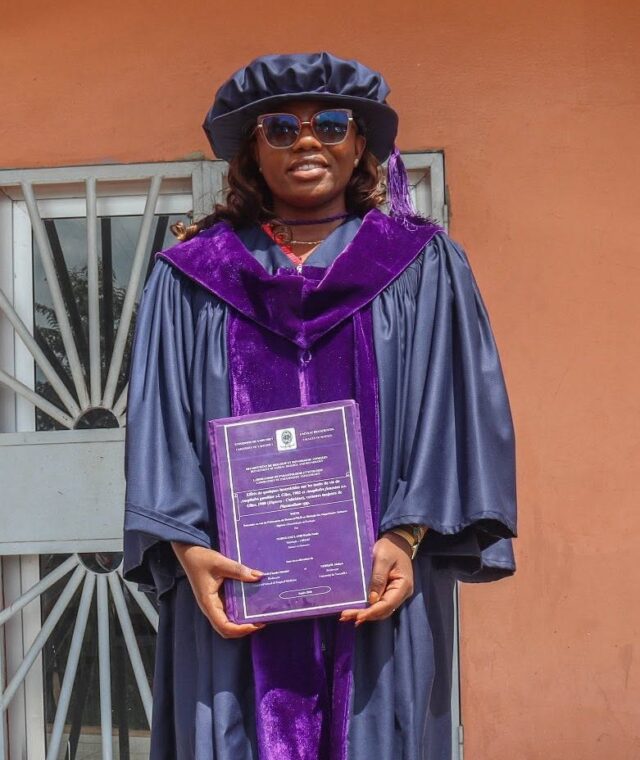
Mrs Sonia Ngongang-Yipmo
Emilie Sonia Ngongang-Yipmo successfully defended her doctoral thesis in the Department of Biology and Animal Physiology (BPA). Her research, titled “Effect of Exposure to Vector Control Tools on the Life-History Traits of Anopheles gambiae s.l. and Anopheles funestus s.s., Major Vectors of Plasmodium spp.”, investigated how exposure to vector control interventions and insecticide resistance influence the biology of malaria mosquitoes and shape malaria transmission dynamics.
The study provides important insights into the long-term effectiveness of malaria control tools at a time when insecticide resistance remains one of the greatest challenges to malaria elimination efforts in Africa.
Reduced Mosquito Longevity Following Exposure to Vector Control Tools
A major finding of the study was that exposure to vector control tools significantly reduced mosquito longevity. The effect was particularly pronounced with next-generation interventions such as Interceptor G2, Royal Guard, Olyset Plus, and Fludora Fusion compared with standard tools including Interceptor, Royal Sentry, Olyset, and deltamethrin-based interventions.
Because malaria transmission depends heavily on mosquito survival, reducing mosquito lifespan may substantially limit the ability of mosquitoes to transmit Plasmodium parasites.
Significant Changes in Mosquito Life-History Traits
Beyond reducing longevity, the study showed that exposure to vector control tools altered several key life-history traits in mosquitoes. Exposed mosquitoes displayed reduced blood-feeding success as well as lower fecundity and fertility.
These biological effects may contribute to a decline in mosquito population density and ultimately decrease malaria transmission potential. The findings highlight the broader impact of vector control tools beyond immediate mosquito mortality.
Persistence of Insecticide Resistance
Despite the encouraging effects observed, the research also demonstrated that mosquitoes carrying insecticide-resistance alleles survived better after exposure to vector control tools and retained biological advantages that could help sustain malaria transmission.
These findings underscore the growing threat posed by insecticide resistance and the urgent need to strengthen strategies aimed at preserving the long-term effectiveness of malaria vector control interventions.
Scientific Publications Emerging from the PhD Research
During her doctoral studies, Dr. Sonia Ngongang also contributed to scientific publications advancing knowledge on malaria vector biology and insecticide resistance.
- https://scijournals.onlinelibrary.wiley.com/doi/full/10.1002/ps.8615
- https://link.springer.com/article/10.1186/s13071-022-05335-2
Recognition of a High-Quality Scientific Contribution
The thesis defense was chaired by Prof. Abraham Fomena of the University of Yaoundé I. The jury highly commended the scientific quality and significance of the work and unanimously awarded the thesis the highest distinction.
This study was conducted under a Wellcome Trust Senior Renewal Fellowship awarded to Prof. Charles Wondji of the Liverpool School of Tropical Medicine (LSTM) and was co-supervised by Prof. Flobert Njiokou of the University of Yaoundé I.
Advancing Malaria Research in Africa
While marking an important academic milestone, this work also opens new perspectives for understanding and better countering the impact of insecticide resistance on the future effectiveness of malaria control strategies.
Dr. Sonia Ngongang’s research represents a valuable contribution to the fight against malaria in Cameroon and across Africa, reinforcing the importance of innovative scientific research in improving public health outcomes.
Congratulations to Dr. Sonia Ngongang on this outstanding achievement.