
The ICARS-funded project, “Preventing the Spread of Antimicrobial Resistance (AMR) from Wastewater through Urban Agriculture in Cameroon,” reached a major milestone with the training of data collectors and the completion of an intensive field data collection phase.
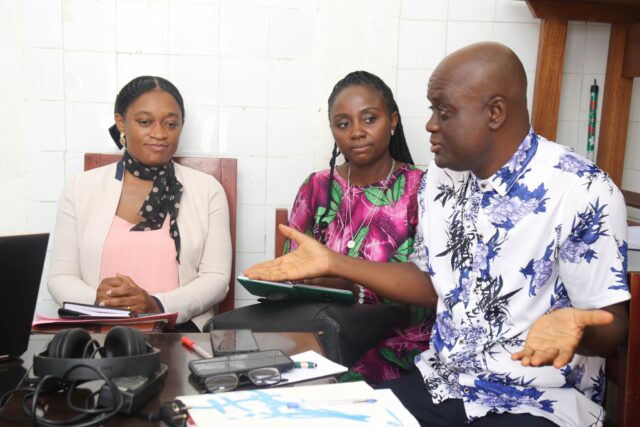
Prof Bougnom Blaise discussing with Data Collectors
The session began with a specialized three-day training session launched on March 16, 2026, at the Faculty of Education of the University of Yaoundé I. Led by Prof. Ngamaleu Henri Rodrigue, coordinator of the community component, and officially opened by Principal Investigator (PI) Prof. Bougnom Blaise, the training equipped six selected research assistants with the skills needed to conduct high-quality fieldwork. Participants were trained in qualitative and quantitative data collection methods, ethical research standards, and the use of standardized tools, including interview guides and observation checklists. Role-play exercises further helped refine their data collection techniques in preparation for field deployment.
Field Data Collection Across Key Urban Sites
Following this capacity-building phase, a 14-day field data collection exercise was conducted across three key urban and peri-urban sites: Nkolondom, Ekounou, and Nkolbisson. These locations were selected for their intense agricultural activity, potential use of contaminated wastewater, and relevance in understanding AMR transmission risks. Using a combination of interviews and structured observations, the trained investigators gathered data from a wide range of stakeholders, including farmers, sellers, consumers, policymakers, and community leaders.
In total, 99 interviews, 51 individual observations, and 56 systemic observations were conducted, resulting in 206 documented activities. The findings revealed important trends, including a strong presence of women in food distribution and consumption networks, diverse agricultural and commercial practices, and varying hygiene conditions that may influence AMR risks. Observations also highlighted the close interaction between farming sites, markets, and community environments, reinforcing the importance of a One Health approach.
Challenges and Data Quality
Despite challenges such as limited participant availability, language barriers, and environmental constraints, the data collection process was successfully completed. The resulting dataset is comprehensive and diverse, supported by both interviews and observations, offering strong potential for subsequent research phases. The data collected provide a solid empirical foundation for upcoming in-depth analyses, which will further inform interventions and policy aimed at reducing AMR risks in urban agriculture.
This initiative forms part of the project’s psychosocial and community-based component, which seeks to better understand behaviors, practices, and environmental factors contributing to AMR transmission in urban agricultural systems.