
Yaoundé, May 4, 2026 — Djondji Kamga Fleuriane Metissa successfully earned her PhD in Microbiology from the Faculty of Science at the University of Yaoundé I (UYI), marking a significant achievement in her academic and reaffirming her commitment to advancing research on infectious diseases in Africa.
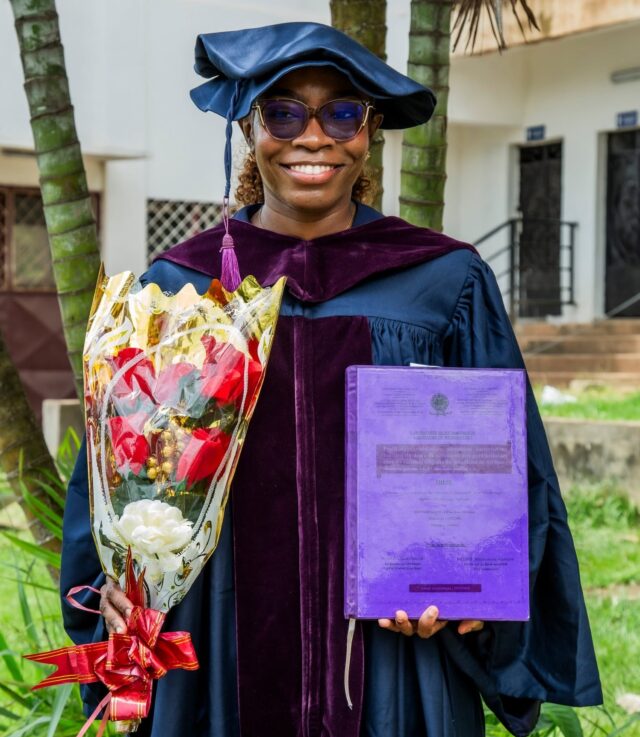
Fleuriane Djondji
Her doctoral thesis, titled “Profile of Bacterial Microbiota Variability According to the Level of Pyrethroid Resistance in Major Malaria Vectors in Africa: Anopheles funestus s.s. and Anopheles gambiae s.s.”, provides new perspectives regarding the relationship between mosquito microflora and escalation of insecticide resistance, an area of increasing interest for malaria vector control and public health. By exploring the bacterial communities associated with two major malaria vectors, she makes a contribution to better understanding the biological mechanisms underlying pyrethroid resistance aggravation and identifies potential avenues for innovative vector control strategies.
Her research was co-supervised by Prof. Nyegue Maximilienne (University of Yaoundé I) and Prof. Charles Wondji (Liverpool School of Tropical Medicine, United Kingdom), reflecting a strong international scientific collaboration.
Innovative Contributions to Malaria Research
Dr. Djondji’s research sheds new light on the growing problem of high-intensity of insecticide resistance among malaria vectors. The findings show that the mosquito’s ability to withstand increasing concentrations of pyrethroid is influenced not only by the mosquito genetic, but also by interactions involving the mosquito host, its bacterial microbiota, and environmental exposure to insecticides.
This work challenges the conventional perception of insecticide resistance an introduces the mosquito bacteria as a key element, yet often overlooked, component of vector biology. The findings show that, as resistance intensifies in field mosquito populations, microbial determinants should be considered alongside conventional genetic markers to better understand the biological mechanisms driving this escalation. Thus, the research highlights the need for National Malaria Control Programs (NMCPs) to broaden current surveillance approaches by integrating microbial signatures that influence resistance, thereby improving detection and management of escalating insecticide resistance. Importantly, the research further identifies specific bacterial taxa consistently associated with higher levels of resistance patterns, opening the door to innovative microbiota-based vector control strategies. Such approaches could complement existing insecticide-based interventions and contribute to more effective malaria control efforts across Africa.
This work resulted in two peer-reviewed publications:
- https://pmc.ncbi.nlm.nih.gov/articles/PMC10053915/
- https://link.springer.com/article/10.1186/s12866-025-04114-0
Outstanding Academic Recognition
Following a rigorous and highly successful defense, Dr. Djondji was awarded the highest distinction of “Excellent” by a jury composed of international experts. This recognition reflects her exceptional academic performance, strong command of the subject, and the scientific relevance of her research. In his remarks, the Chair of the Jury, Prof. Essia Ngang Jean Justin (UYI), praised the quality and impact of her work. He also congratulated the Department of Microbiology for nurturing such a talented and promising young researcher.
A Promising Future in Science
This achievement marks a major milestone in Dr. Fleuriane Djondji’s academic journey. Her dedication, excellence, and valuable scientific contributions position her as a rising figure in the field of microbiology and malaria research.