
This was on Monday, 11th May 2026, at the Department of Biology and Animal Physiology of the University of Yaoundé I.
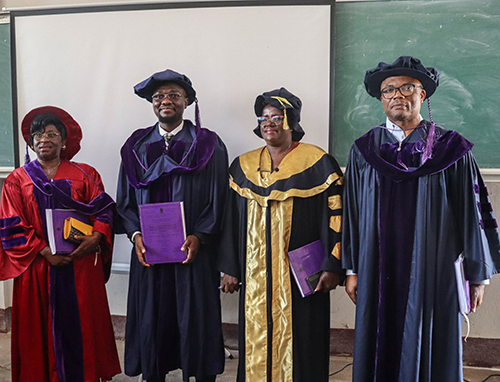
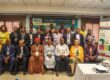
Brice Natchema with some members of the jury
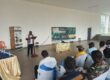
The atmosphere in Room S01–02 immediately signaled that this would be no ordinary doctoral defense. For Brice Natchema Fonkou, then a PhD candidate, the day marked the culmination of years of dedication, scientific rigor, and relentless hard work. As colleagues, students, researchers, friends and family members gathered in anticipation, the chair of the jury, Professor Njiokou Flobert, officially opened the session and invited the candidate to begin his presentation.
Over the course of more than forty minutes, Brice Natchema presented and defended his doctoral thesis entitled “Influence of insecticide resistance on the transmission of Plasmodium spp. in Anopheles funestus Giles, 1900, a major malaria vector in Cameroon.” His presentation stood out for its clarity, scientific depth, and excellent structure. Richly illustrated with figures and detailed analyses, the work highlighted the extent and significance of his findings with remarkable confidence and precision. Throughout the defense, he spoke with the assurance and authority of an emerging expert in malaria vector biology and insecticide resistance research.
Three Major Scientific Findings
One of the most striking findings of the study revealed that wild Anopheles funestus mosquitoes, referred to as Generation Zero populations, displayed extremely high levels of resistance to pyrethroid insecticides, which remain the primary compounds used in mosquito bed nets. These mosquitoes survived insecticide doses up to ten times higher than standard diagnostic concentrations. Even more concerning, the research demonstrated that this heightened resistance was closely associated with increased Plasmodium transmission, suggesting that resistant mosquito populations may significantly contribute to the persistence of malaria transmission.
The study also revealed alarmingly high malaria transmission intensities linked to Anopheles funestus. The research team estimated approximately 792 infectious bites per person per year overall, with nearly 1116 infective bites occurring indoors and 468 outdoors. These findings provide strong evidence that Anopheles funestus remains a major driver of malaria transmission both inside and outside households in Cameroon, reinforcing the urgent need for strengthened vector control strategies.
Another important aspect of the research focused on the metabolic resistance markers L119F-GSTe2 and G454A-CYP9K1. The study demonstrated that these markers not only help mosquitoes survive insecticide exposure in natural settings, but also influence their biting behaviour. Resistant mosquitoes were observed biting predominantly between 5 a.m. and 6 a.m., much later than the usual 2 a.m. peak observed in susceptible mosquito populations. This behavioural shift may reflect increased aggressiveness during early morning hours, when people are more likely to be awake and less protected by bed nets. Furthermore, the L119F-GSTe2 marker showed a particularly strong association with higher Plasmodium transmission intensity.
This work resulted in two peer-reviewed publications:
🔗 https://doi.org/10.1186/s12879-023-08698-8
🔗 https://doi.org/10.21203/rs.3.rs-8136033/v1
A High-Level Scientific Debate
Following the presentation, members of the jury engaged the candidate in an open and intellectually stimulating scientific discussion. The panel, composed of academics and internationally recognized experts, acknowledged both the originality and robustness of the work. Their observations focused mainly on minor clarifications and formal adjustments rather than substantive criticisms, demonstrating the solid scientific foundation of the research and its potential contribution to malaria control efforts in Cameroon and beyond.
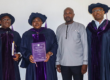
At the end of the deliberations, the verdict was clear and unequivocal: the jury unanimously awarded Brice Natchema Fonkou the Highest Distinction. This outstanding achievement reflects not only his personal dedication and excellence in scientific research, but also the quality of mentorship and supervision he received throughout his doctoral journey. The success of the work was strongly supported by the excellent scientific guidance provided by Professor Lucia Nkengazong from the Institute of Medical Research and Medicinal Plants Studies (IMPM), Professor Tombi Lucia of the University of Yaoundé I, and Professor Charles Wondji of the Liverpool School of Tropical Medicine (LSTM).
Brice Natchema’s achievement represents an important contribution to ongoing efforts aimed at understanding malaria transmission dynamics and insecticide resistance in Africa.