

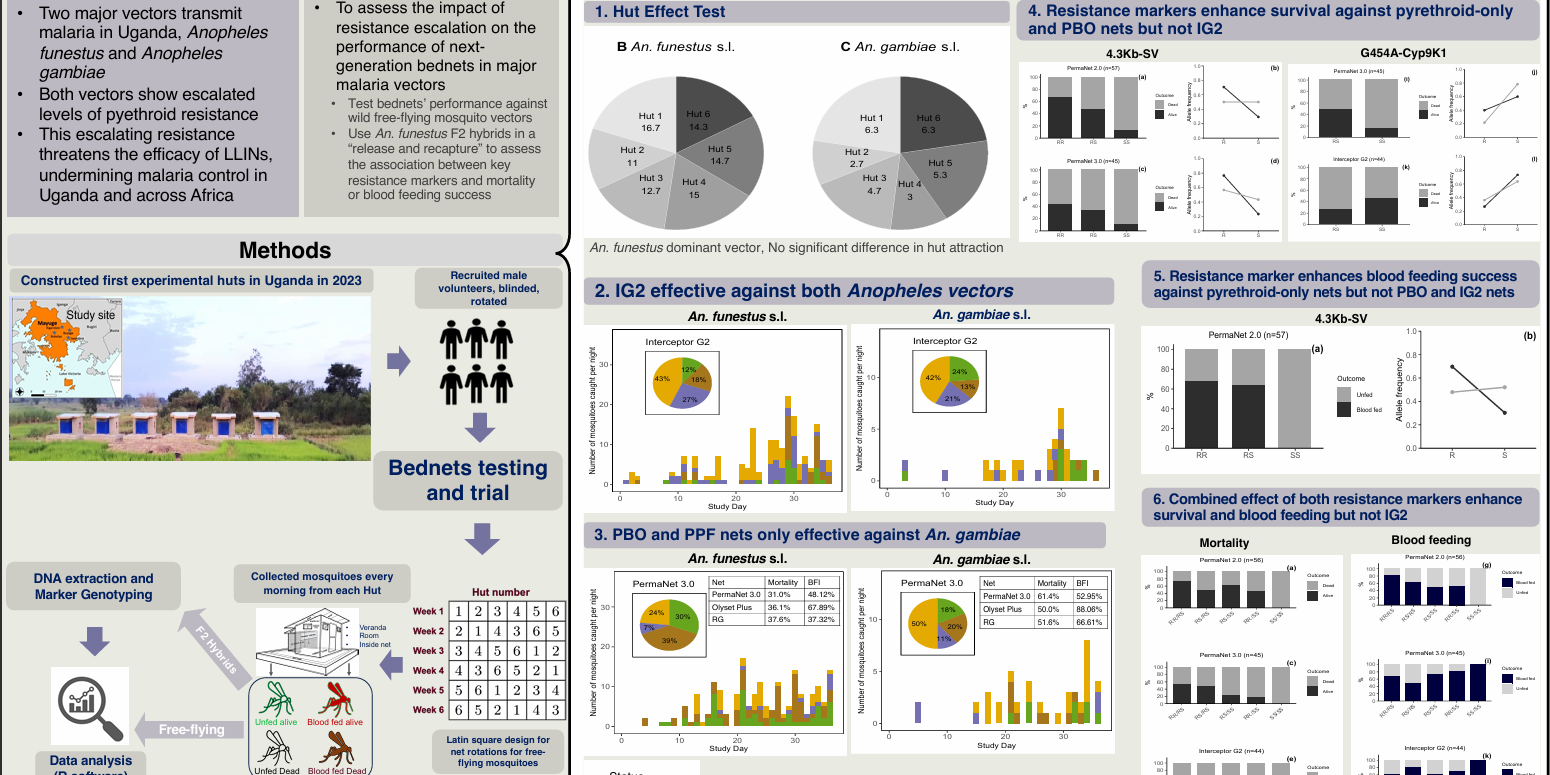
In many parts of sub-Saharan Africa, malaria mosquitoes have become resistant to pyrethroids, the insecticides used for decades on standard bed nets. This resistance makes malaria harder to control. This study, published in Scientific Reports in January 2026, evaluated newly introduced Long-Lasting Insecticidal Nets (LLINs) with different modes of action. Researchers conducted Uganda’s first experimental hut trials: that mimic real sleeping conditions to see how resistant wild mosquitoes (Anopheles funestus and Anopheles gambiae, the main malaria vectors) behave when people sleep under different nets.
The Interceptor G2 net, treated with chlorfenapyr plus pyrethroid, was the most effective. It killed about 70% of Anopheles funestus and 63% of Anopheles gambiae, the two main malaria vectors. By contrast, the standard pyrethroid-only net killed only about 25% of both species. Other advanced nets killed fewer Anopheles funestus (around 30–38%) but did moderately better against Anopheles gambiae (50–61%). Genetic analysis showed that resistance mutations helped mosquitoes survive on pyrethroid-only and Piperonyl- butoxide (PBO) nets, but not on Interceptor G2. This means chlorfenapyr works in a way mosquito have not yet overcome.
While PBO nets were best at stopping bites, Interceptor G2’s stronger killing power makes it especially valuable in areas with high resistance. PBO and pyriproxyfen nets remain useful where Anopheles gambiae is more common.
This study was led by Dr Ambrose Oruni, post-doctoral researcher at CRID. The study recommends regular monitoring of mosquito species, net performance, and resistance levels. This will guide smart deployment and rotation of LLINs, helping sustain malaria prevention as resistance evolves.