
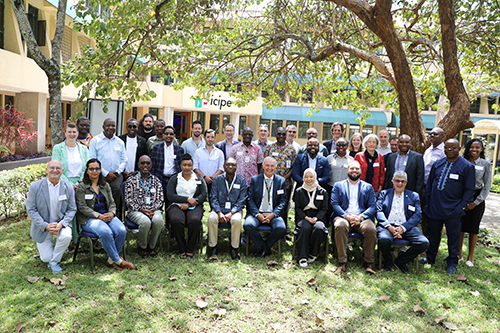
Family picture taken at ICIPE during the kick-off meeting
The IMPACTING project (Integrated Multi-vector-borne diseases Platform to Assess how Global Change impacts Transmission using Innovative systems modeling, Novel monitoring tools, and transmission blockinG micro-organisms) was officially launched in September 2025. The kick-off meeting took place at the Duduville Campus of the International Centre of Insect Physiology and Ecology (ICIPE) in Nairobi, Kenya. Funded by the European Union Commission through its Global Health EDCTP3 programme, the project has a total budget of approximately £5.25 million, with £458,336 allocated to CRID to support its contributions within the consortium
CRID is a key partner in this initiative. Its team includes Dr. Basile Kamgang (Principal Investigator), Dr. Melachio Trésor (Research Scientist), and Dum-Buo Nnamdi (WP3 in-country Lead). The project is implemented by a multidisciplinary consortium comprising ICIPE, the French Agricultural Research Centre for International Development (CIRAD), the French National Research Institute for Sustainable Development (IRD), the Institute of Social Medicine (ISM), the Society for Parasitology and Infectious Diseases (SPI), Centre Pasteur du Cameroun (CPC), and other partners, with CIRAD serving as the overall coordinator.
Core Aim
The primary aim of IMPACTING is to understand how climate and global change influence the transmission dynamics and geographical distribution of vector-borne diseases (VBD), and to design innovative surveillance and control strategies that reduce risks for vulnerable populations, particularly in Sub-Saharan Africa. By integrating digital and biological sciences, the project seeks to strengthen health security through African-led research, innovation, and capacity building.
Specific Objectives
IMPACTING will model the risk of VBD spread under global change, focusing on mosquitoes (malaria, dengue, chikungunya, yellow fever), tsetse flies (human African trypanosomiasis), blackflies (onchocerciasis), and ticks (Crimean-Congo haemorrhagic fever). It will develop new monitoring and diagnostic tools to improve surveillance, establish pipelines to identify transmission-blocking microorganisms, and define novel control strategies. The project also emphasizes community engagement, working with rural and urban populations to co-develop solutions that overcome barriers to monitoring and control. Finally, it will create a multi-disease risk prediction dashboard to support evidence-based policymaking and climate-resilient interventions.
CRID plays a central role in three work packages. In WP2 (Surveys), CRID contributes to the development of innovative monitoring tools. In WP3 (Co-Create), it engages communities to identify barriers and co-develop solutions. In WP4 (Control), CRID helps establish molecular pipelines to study vector microbiomes and design transmission-blocking tools.
Expected Outcomes
The four-year project is expected to deliver improved surveillance and control strategies for multiple vector-borne diseases, identify effective transmission-blocking microorganisms, and strengthen community engagement through co-created solutions. It will also provide a risk prediction dashboard to guide policy and interventions, while fostering collaborations across Africa and Europe.
Consortium and Alignment
IMPACTING brings together eight research institutes, two universities, and one Small and Medium-sized Enterprise from Kenya, Cameroon, Mozambique, France, and Portugal. It integrates expertise in social sciences, entomology, ecology, epidemiology, genomics, bioinformatics, modelling, and software development, ensuring an interdisciplinary approach.
The project aligns with the Africa CDC Strategic Plan (2023–2027) and the EU Global Health Strategy. By advancing African leadership in research and innovation, building capacity, and engaging communities and public health actors, IMPACTING contributes to stronger health security and resilience against climate-driven disease threats.



2 Comments