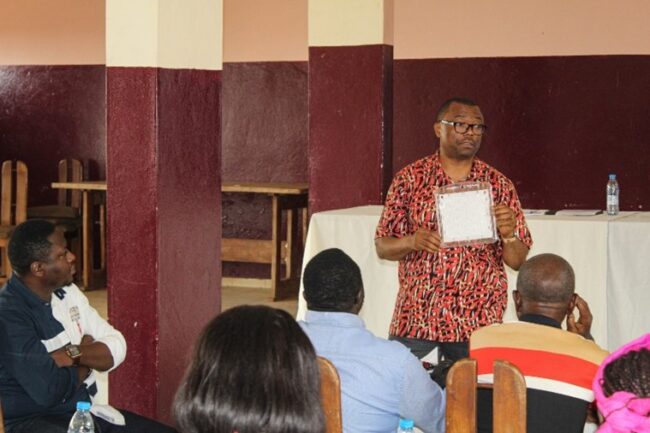
Prof Charles Wondji presenting a spatial repellent during a stakeholder engagement meeting

CRID awarded US$18 million grant for Catalyzing the Adoption of a Novel Vector Control Tool against malaria

Prof Charles Wondji, CRID’s Executive Director and Head of the LSTM Research Unit at CRID, will lead a team of experts to generate robust evidence to support the adoption of spatial repellents as a novel tool to reduce malaria burden in Africa. Malaria prevention relies heavily on insecticide-based interventions, notably insecticide-treated nets. However, efforts to…

Graphical abstract

PUBLICATION: Evidence of microbiome contribution to the escalation of pyrethroid resistance in the major malaria vectors Anopheles gambiae s.s. and Anopheles funestus s.s, by Fleuriane Djondji & al.

Anopheles mosquitoes are becoming increasingly resistant to commonly used insecticides, particularly pyrethroids, the primary chemicals in bed nets across Africa. Beyond genetic mutations, which are known to play a key role in this enhanced resistance, researchers are now investigating another potential contributor: the mosquito’s microbiome. Mosquito microbiome refers to all the microorganisms (like bacteria, fungi,…