Funded by Unitaid, the project entitled Catalyzing the Adoption of a Novel Vector Control Toolbox (CANVeCT) is generating evidence to support the introduction, deployment and scale-up of innovative vector control interventions.

CANVeCT team during first consortium meeting in Mbankomo, Cameroon
Unitaid is investing US$18.1 million in the five-year CANVeCT project led by the Centre for Research in Infectious Diseases (CRID) in Cameroon and implemented in partnership with the Liverpool School of Tropical Medicine (LSTM) and the London School of Hygiene & Tropical Medicine. The CANVeCT project aims to monitor and evaluate the large-scale rollout of spatial emanators supported by the U.S. Government and The Global Fund, assess their use in humanitarian settings, and expand the evidence base on insecticide-treated baby wraps.
Supporting the Scale-Up of Innovative Vector Control Interventions
As countries introduce new malaria prevention tools into routine programmes, there is a growing need for evidence on how these interventions perform under real-world conditions. Beyond demonstrating effectiveness, policymakers and programme managers require information on delivery strategies, operational feasibility, user acceptability, coverage, adherence and cost-effectiveness to guide implementation decisions.
CANVeCT is established to address these evidence gaps and support countries in making informed decisions on the use of innovative vector control interventions. Through implementation research and operational evaluations, the project will generate evidence that can strengthen programme delivery, inform policy development and accelerate the adoption of high-impact malaria prevention tools.
Evaluating Spatial Emanators at Scale and in Humanitarian Settings
A major component of CANVeCT focuses on the monitoring and evaluation of the large-scale deployment of spatial emanators through a U.S. Government and Global Fund-supported rollout across sub-Saharan Africa. The project will generate evidence on intervention effectiveness, implementation performance, population coverage, user adherence and operational feasibility under routine programme conditions.
By documenting lessons learned during implementation, CANVeCT will help countries identify the most effective approaches for deploying spatial emanators at scale and optimize delivery strategies in different epidemiological and operational contexts. The project will also contribute evidence related to Aedes-borne diseases, supporting a better understanding of how spatial emanators may fit within broader vector control strategies.
CANVeCT will evaluate the effectiveness, acceptability and operational feasibility of deploying spatial emanators alongside long-lasting insecticidal nets among displaced populations and other crisis-affected communities. The findings will provide valuable evidence to guide malaria prevention strategies in some of the most vulnerable populations across Africa

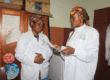
Prof Charles Wondji (CANVeCT lead) and Dr Magellan Tchouakui (CANVeCT co-lead) during a community engagement meeting at the study field site in Cameroon
Expanding the Evidence Base on Insecticide-Treated Baby Wraps
The project will also conduct implementation research on insecticide-treated baby wraps, an innovative intervention designed to provide additional protection to infants during the first months of life. By generating evidence on effectiveness, user acceptability and programmatic feasibility, CANVeCT aims to inform future policy and programme decisions regarding the use of insecticide-treated baby wraps as a complementary tool for protecting young children from malaria and other vector-borne diseases.
Professor Charles Wondji, Executive Director of CRID and Principal Investigator of CANVeCT, stated: “Spatial emanators and insecticide-treated baby wraps have the potential to accelerate malaria elimination efforts. We are glad to have been awarded this project by Unitaid and look forward to generating the evidence needed for a full recommendation by WHO and to catalyze its rapid adoption for malaria control.”
Dr. Magellan Tchouakui, Research Scientist at CRID and CANVeCT Co-Lead, added: “We are very excited about this Unitaid-funded project at CRID. We aim to generate strong evidence on spatial emanators as a novel tool to reduce malaria in Africa alongside insecticide-treated baby wraps. This work could transform malaria control and support updated WHO recommendations, ultimately helping to save many lives in Cameroon and across the continent.”
Advancing African Leadership in Global Health Research
CANVeCT is particularly significant as it marks the first Unitaid-funded malaria project led by a south-based partner in a malaria-endemic country, emphasizing local ownership and leadership in a region where more than 90% of global malaria deaths occur. Through increased support for south-based institutions, Unitaid aims to promote equity, sustainability and greater relevance for the communities most affected by malaria.