
On January 16, 2026, Tatiane Assatse Matakafo, Research Assistant at CRID, successfully defended her Ph.D thesis in Parasitology and Ecology at the Faculty of Science, University of Yaoundé I.
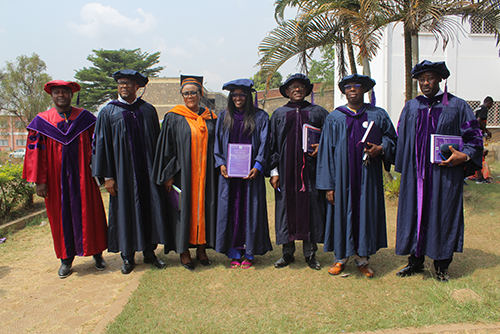
Tatiane Assatse surrounded by the members of the jury
Her research focused on characterising the molecular basis of resistance to neonicotinoids (a novel insecticide class recommended by WHO for vector control) in the main African malaria vectors Anopheles funestus s.l. and Anopheles gambiae s.l.. Drawing on extensive field collections from Cameroon, the Democratic Republic of Congo, Ghana, Uganda and Malawi, she combined advanced transcriptomic analyses with bioassays to characterise how malaria vectors respond to a new class of insecticides, the neonicotinoids.
Dr Assatse evaluated three neonicotinoids—clothianidin, imidacloprid and acetamiprid—and showed that, overall, these compounds remain highly active against malaria vectors, particularly when used in specific mixtures. However, her results also revealed early signs of reduced susceptibility in mosquito populations that are already strongly resistant to older insecticides such as pyrethroids. This suggests that some of the same genetic changes driving pyrethroid resistance may also compromise neonicotinoid efficacy. Notably, she demonstrated that the metabolic gene CYP6M2 plays a direct role in reducing mosquito susceptibility to clothianidin.
Key Recommendations
Dr Assatse Tatiane emphasises that neonicotinoids are a valuable addition to the vector control toolbox, but their use must be carefully managed. She recommends:
– Restricting and rotating neonicotinoid use in both public health and agriculture to delay the emergence of resistance.
– Strengthening collaboration between health, agriculture and environment ministries to coordinate insecticide policies and preserve these compounds.
– Implementing regular resistance monitoring to detect early warning signs and adapt management strategies in real time.
The examining jury, chaired by Prof. Flobert Njiokou, commended the depth, originality and rigor of her work and awarded her the Highest Distinction. This recognition highlights both the scientific excellence of her thesis and its importance for sustaining effective malaria vector control and advancing elimination efforts in Africa.