

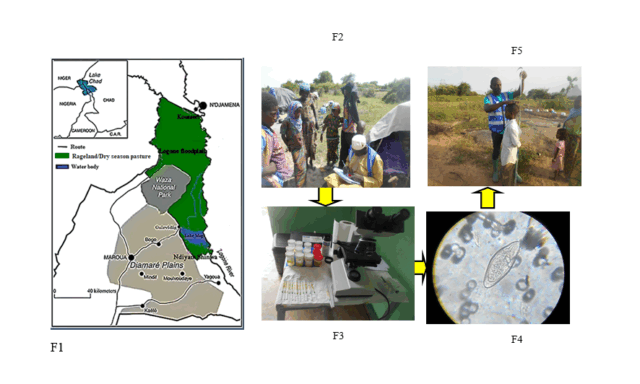
(F1) Map showing the Logone floodplain in green; (F2) Sampling of participants and administration of questionnaire; (F3) urine samples analysis (F4) Egg of schistosome observed and (F5) Evaluation of the height of an infection participant prior to drug administration
Urinary Schistosomiasis is a disease caused by a tiny parasite that lives in freshwater. People can get infected when they come into contact with contaminated water—like rivers, lakes, or ponds—especially when swimming, washing, or working. The parasite enters the body through the skin and eventually settles in the bladder and urinary tract, where it can cause serious health problems.
CRID scientists undertook a study to determine the burden of urinary schistosomiasis, a neglected tropical disease, in nomadic pastoralists who settle periodically in the Logone floodplain, a wetland vital for transhumant pastoralists of the Lake Chad Bassin, located in northern Cameroon. Nomadic pastoralists are communities who move from place to place with their livestock, such as cattle, sheep, goats, or camels, in search of pasture and water. Researchers assessed and compared how nomadic and sedentary (stationary) populations understand, feel about, and respond to the disease in question.
Results
Their results showed that nearly all of pastoralists were aware of the disease, and highlighted differences of perceptions and practices between the local and the foreign nomadic pastoralist. For example, almost all foreign pastoralists considered urinary schistosomiasis as an unpreventable disease whereas the majority of the local nomads thought the contrary. Eggs of Schistosoma haematobium, the causative agent urinary schistosomiasis, was detected in local nomadic pastoralists tested, with the presence of blood in urine more frequent in infected people. In addition to blood in the urine, pain during urination is a common symptom of urinary schistosomiasis. However, the disease can be prevented by avoiding swimming or bathing in untreated freshwater in affected areas, and by using clean water for washing and drinking.
This study reveals the presence of cases of urinary schistosomiasis among nomadic pastoralists of northern Cameroon and calls for more investigations to assess the risk of its dispersion across borders. This study was conducted by Dr Pierre Fongho Suh, post-doctoral researcher at CRID. Read more: https://doi.org/10.1186/s12982-025-00835-9