
On September 3, 2025, the kick-off and stakeholder engagement workshop for the project titled “Preventing the Spread of AMR from Wastewater in Urban Agriculture in Cameroon” was held at the Franco Hotel in Yaoundé.
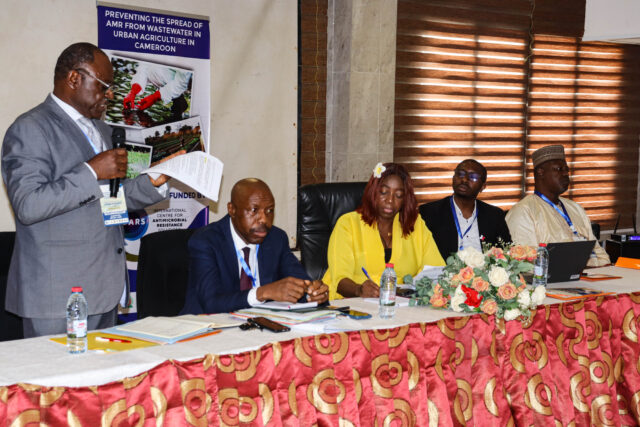
Prof Flobert Njiokou, CRID’s Deputy Executive Director, giving his opening remarks
The event began with a general presentation of the ICARS Cameroon project by Prof. Bougnom Blaise, Principal Investigator. He explained that antimicrobial resistance (AMR) occurs when someone becomes ill but does not recover after taking antibiotics, as the drugs have become ineffective. “AMR is a serious public health issue, although it is a silent killer,” he emphasized. Among the contributing factors to the rising AMR rates in Cameroon, he cited poor sanitation and the lack of regulation in antibiotic use in both healthcare and agriculture. “With an adequate health policy, we could prevent up to 750,000 AMR-related deaths annually in Low- and Middle-Income Countries (LMICs)”, he added.
In his opening remarks, Prof. Flobert Njiokou, CRID’s Deputy Executive Director, highlighted the institution’s commitment to connecting stakeholders through its partnership with the International Centre for Antimicrobial Resistance Solutions (ICARS). He stressed the importance of co-creating evidence-based solutions tailored to local realities in Cameroon and scalable across Africa. Sunday Ochai, Science Advisor at ICARS supporting projects in LMICs, delivered remarks on behalf of the funder. He reiterated that AMR is a One Health issue, involving human, environmental, and animal health. He emphasized ICARS’ focus on context-specific research solutions.
Prof Bougnom Blaise, Principal Investigator of the project
Representatives from the Ministries of Health, Agriculture, and Environment also spoke during the session. The workshop included fruitful discussions with farmers and local authorities, helping refine the project’s implementation strategies and clarify stakeholder expectations. This project, implemented by the Centre for Research in Infectious Diseases (CRID) with support from ICARS, aims to generate evidence, co-design effective interventions, and advocate for appropriate policies to combat AMR. The workshop enabled participants to develop a shared understanding of the project’s scope, objectives, and methodologies. Attendees included government ministries, international partners, local stakeholders, universities, and research institutions.
The following day, the ICARS delegation visited the CRID to tour its state-of-the-art facilities. The delegation included Dr. Holy Akwar, ICARS Science Advisor; Dr. Sunday Ochai; and Prof. Jan-Ulrich Kreft from the University of Birmingham, an international subject matter expert. The visit also provided an opportunity to engage with Master’s and PhD students working on AMR, fostering a moment of connection and collaboration. This initiative, funded by the International Centre for Antimicrobial Resistance Solutions, will run from April 2025 to March 2029.