

Analyzing the genomes of hundreds of Anopheles funestus mosquitoes uncovers new patterns in how this key malaria vector is adapting over time.
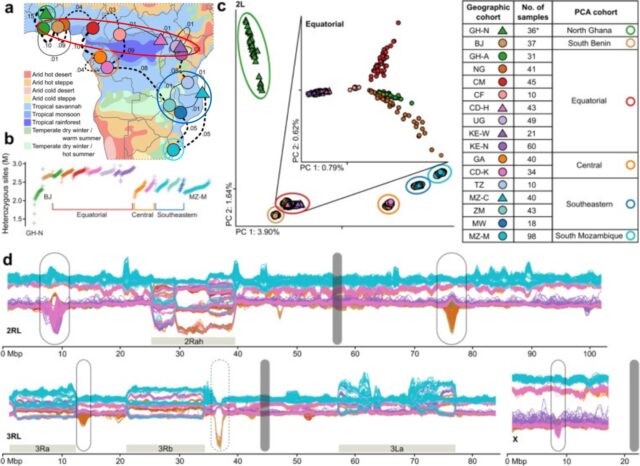
Graphical abstract
Yaoundé, Cameroon — September 18, 2025.
The Centre for Research in Infectious Diseases (CRID) is proud to announce its contribution to a landmark study published today in Science, which sheds new light on the genetic evolution of Anopheles funestus, one of Africa’s most prolific and understudied malaria-transmitting mosquito species. In collaboration with the Wellcome Sanger Institute, the Liverpool School of Tropical Medicine (LSTM) and scientists across Africa, CRID researchers helped sequence the whole genomes of over 650 modern and 45 historic Anopheles funestus specimens, collected across 16 African countries with nearly half of these specimens provided by Prof Charles Wondji’s Team. The study reveals that Anopheles funestus populations across equatorial Africa are genetically interconnected over vast distances, while others remain isolated and genetically distinct.
This complex population structure has significant implications for malaria control strategies, particularly as the species continues to evolve resistance to insecticides. This finding validates patterns of insecticide resistance elucidated by Prof Wondji and collaborators showing for example that Cameroon (Central Africa) and Uganda (East) tended to share the same molecular markers (e.g. G454A-CYP9K1) of metabolic resistance to pyrethroids. Importantly, the research also found that a key gene targeted by gene drive technologies in Anopheles gambiae is highly conserved in Anopheles funestus, opening the door for future genetic control tools to be adapted for this species.
Voices from the study
Professor Charles Wondji, Executive Director of CRID and co-author, said: “For too long, Anopheles funestus has been neglected despite its key role in malaria transmission across Africa. I am delighted that this continent-wide whole genome study is now published. My team at LSTM/CRID is proud to have contributed to this major milestone that will facilitate future control interventions against this major vector.”
Dr. Marilou Boddé, first author and Postdoctoral Fellow (Institut Pasteur de Madagascar / LIB Bonn), said: “Anopheles funestus is genetically complex and evolving fast under pressure from insecticide use. This work is progress in generating a foundational genomic understanding of Anopheles funestus. The insights from this study are crucial for designing future tools that need to work across entire continents for the benefit of those living in countries affected by malaria.”
Dr. Mara Lawniczak, Senior Group Leader at the Wellcome Sanger Institute, added: “We find some populations readily sharing variation across the African continent, while others are close neighbours but genetically distinct. This is a challenge for vector control. Even if the Gambiae Complex disappeared today, malaria would still rage through Africa until Anopheles funestus is also effectively targeted.”
CRID’s involvement in this study underscores its commitment to advancing genomic surveillance and vector biology research in Africa. The findings will inform smarter, more targeted malaria control strategies and contribute to the broader goal of malaria elimination across the continent. Read the full article: https://www.science.org/doi/10.1126/science.aea9024
Notes to the editor
About CRID
The Centre for Research in Infectious Diseases (CRID) is a non-profit research Centre established in 2018 that provides an excellent environment for conducting high-quality, internationally recognized research on infectious tropical diseases in Cameroon and across Africa. CRID’s vision is to improve living conditions by carrying out impactful research and enhancing the skills of researchers specializing in infectious tropical diseases, while its mission is to help fight these diseases in Africa through advancing knowledge and building research capacity in affected regions.