
On 25th August 2025, Dr Komi Fiaboe, an agricultural entomologist and Country Representative of the International Institute of Tropical Agriculture (IITA) in Cameroon visited CRID. This meeting was a significant step towards establishing a partnership between agricultural research and global health.
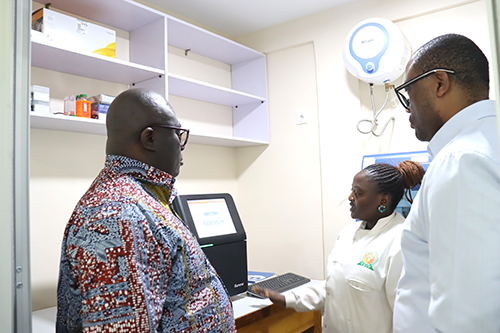
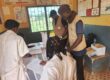
Dr Estelle Mewamba showcasing CRID Sequencing facilities
The guest was welcomed by Prof. Charles Wondji, the Executive Director of CRID, alongside senior researchers and administrative staffs. They had a conversation, during which they explored ongoing activities between the LSTM Research Unit at CRID and IITA. They also discussed future opportunities to adopt a One Health perspective to connect human, animal, and environmental health in future research activities. Additionally, they shared ideas on the potential health impacts of insecticide use in agriculture and the development of resistance in malaria vectors.
CRID’s ambition to build an annex insectary at IITA Cameroon
Dr. Komi toured the CRID insectary, admiring the setup used to rear mosquitoes and test their susceptibility profiles. As part of this collaboration, CRID plans to replicate such an insectary at IRAD (L’Institut de Recherche Agricole pour le Développement), of the IITA’s local branch in Cameroon. Dr Elysée Nchoutpouen, focal point for the initiative, emphasized the importance of setting up an insectary within the agricultural research sector: “To conduct entomological research, scientists require large quantities of mosquitoes. These must be reared in a controlled insectary environment to enable laboratory studies and other investigations, including evaluating the efficacy of vector control tools, insecticide susceptibility, and vector-parasite interactions.”
In response to growing population demands, the agricultural industry has become increasingly reliant on pesticides to control pests and boost crop yields. While this approach is effective in terms of productivity, this widespread use of chemicals also affects non-target insect populations, particularly Anopheles mosquitoes which transmit malaria. Constant exposure to these substances exerts selective pressure on mosquito populations, potentially accelerating the development and spread of insecticide resistance. Effective pest management requires a balanced approach, one that safeguards ecosystem health while controlling harmful species. Addressing insecticide resistance in both public health and agriculture is essential to ensuring long-term food security and protecting human health.
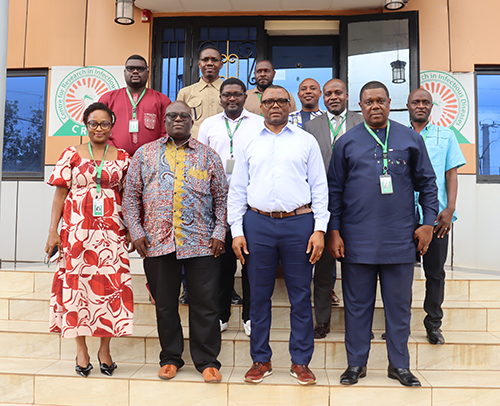
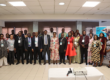
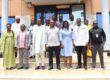
Family picture
A new era of collaboration
During his visit to the laboratory, Dr Komi Fiaboe was impressed by CRID’s sequencing platform, which is powered by an ABI3500 Genetic Analyzer, and a recently acquired Novaseq6000. He appreciated the organization’s capacity to conduct advanced genomics research locally, rather than having to send samples abroad, as previously. Prof Charles Wondji expressed his enthusiasm about welcoming IITA researchers to CRID for Next Generation Sequencing (NGS) training.
The construction of a CRID’s annex insectary on the IITA campus could foster collaboration between IITA and LSTM/CRID, while simultaneously advancing the integration of human health and agriculture through the implementation of a One Health approach.