

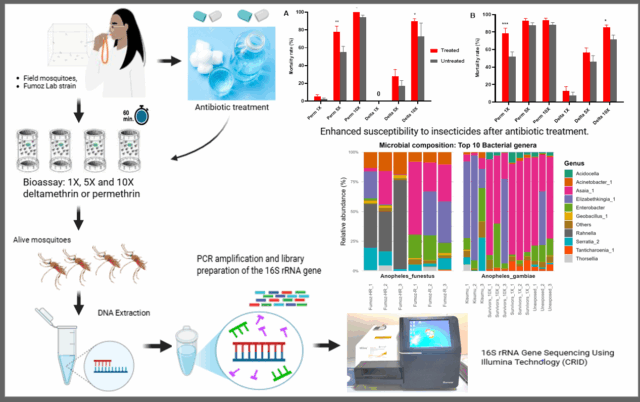
Graphical abstract
Anopheles mosquitoes are becoming increasingly resistant to commonly used insecticides, particularly pyrethroids, the primary chemicals in bed nets across Africa. Beyond genetic mutations, which are known to play a key role in this enhanced resistance, researchers are now investigating another potential contributor: the mosquito’s microbiome. Mosquito microbiome refers to all the microorganisms (like bacteria, fungi, viruses, and protozoa) that live inside and on mosquitoes—especially in their gut, salivary glands, and reproductive organs.
This study investigated whether the microbial communities of Anopheles gambiae s.s. (Anopheles gambiae sensu stricto) and Anopheles funestus s.s. influence their ability to withstand high concentrations of pyrethroid insecticides, deltamethrin and permethrin. By comparing mosquito populations with different resistance profiles, we identified a significant overrepresentation of certain bacterial genera, such as Burkholderia, Pseudomonas, Rahnella and Leucobacter, among the highly resistant individuals. Furthermore, treating mosquitoes with antibiotics (penicillin/streptomycin) increased their susceptibility to pyrethroids, suggesting that the microbiota may play a supportive role in enhancing insecticide resistance.
These findings highlight the urgent need to consider the microbial allies of mosquitoes, as well as genetics, when developing new malaria control tools. A deeper understanding of how the microbiome contributes to insecticide resistance could open the door to innovative approaches, such as disrupting specific bacteria, to improve the effectiveness of insecticide-based interventions and reinforce efforts to combat malaria. This study was led by Fleuriane Metissa Djondji , PhD candidate and Research Assistant at CRID. It was published in BMC Microbiology Journal on July 02, 2025.
Read more: https://bmcmicrobiol.biomedcentral.com/articles/10.1186/s12866-025-04114-0