

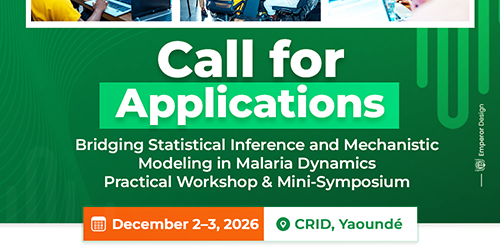
Bridging Statistical Inference and Mechanistic Modeling in Malaria Dynamics
This training aims to explore how mechanistic models and statistical inference can be combined to improve our understanding of malaria transmission dynamics. By linking biological processes that drive malaria transmission with real-world data, participants will learn how these complementary approaches can be used to estimate key epidemiological parameters, identify transmission patterns, and generate evidence to support more effective malaria control and elimination strategies.
Training dates : 2–3 December 2026
Location: Centre for Research in Infectious Diseases (CRID), Yaoundé, Cameroon
What to Expect
Participants will:
- Collaboratively develop a malaria transmission model by integrating biological and mathematical perspectives.
- Learn how to fit models to data through hands-on exercises and ready-to-use code.
- Explore the potential and limitations of modeling for public health decision-making through an interactive policy-modeling panel discussion.
Who Can Apply?
Applications are welcome from:
- Modelers and mathematicians
- Biologists and entomologists
- Data scientists and statisticians
- Students and early-career researchers
- Public health professionals interested in disease modeling
No prior modeling experience is required. The workshop is designed for participants from diverse academic and professional backgrounds.
Important Information
✅ Participants must bring their own laptop.
✅ Women are strongly encouraged to apply.
How to Apply
Complete the online application: 🔗 https://docs.google.com/forms/d/e/1FAIpQLSe0-8m00abqHa77hijDVRLea3-ribOh08WNPsOcatijxuLUpQ/viewform?usp=header
Application deadline: 3 November 2026:
Selected candidates will be notified within two weeks following the application deadline.
This workshop is organized by the AMMnet Cameroon Chapter and CRID, with support from AMMnet.


