
Graphical abstract
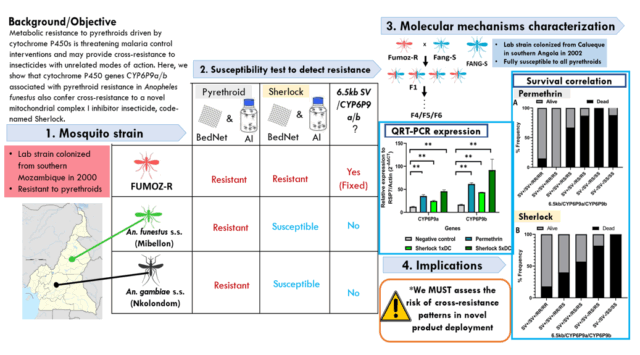
Mosquito resistance to insecticides is one of the biggest threats to malaria control efforts. This study shows that the same genes (CYP6P9a/b) that allow the major African malaria vector Anopheles funestus, to be resistant to pyrethroid insecticides can also render them less sensitive to Sherlock, a new insecticide designed to target mosquito energy production.
Using mosquito bioassays and previously designed DNA-based assays, we found that while pyrethroid-resistant field mosquitoes from Cameroon (lacking these markers) exhibited high susceptibility, pyrethroid-resistant lab strains (carrying the markers) survived Sherlock exposure more often.
This suggests that resistance to existing insecticides (pyrethroids) can also offer protection to mosquitoes against new ones still in development, making malaria control more difficult.
Our findings highlight how genetic tools can help predict cross-resistance with current chemical classes in advance and guide smarter use and deployment of new insecticides; protecting their effectiveness for malaria control. This study published in BMC Genomics was led by Theofelix Tekoh, PhD student at CRID. Read more : https://doi.org/10.1186/s12864-025-11984-1