
Scientists from the Centre for Research in Infectious Diseases (CRID), in collaboration with the Liverpool School of Tropical Medicine (LSTM), have achieved a major milestone in the fight against malaria. For the first time, researchers have identified a DNA marker linked to metabolic pyrethroid resistance in west and Central African population of Anopheles gambiae, one of the most important malaria-carrying mosquito species.
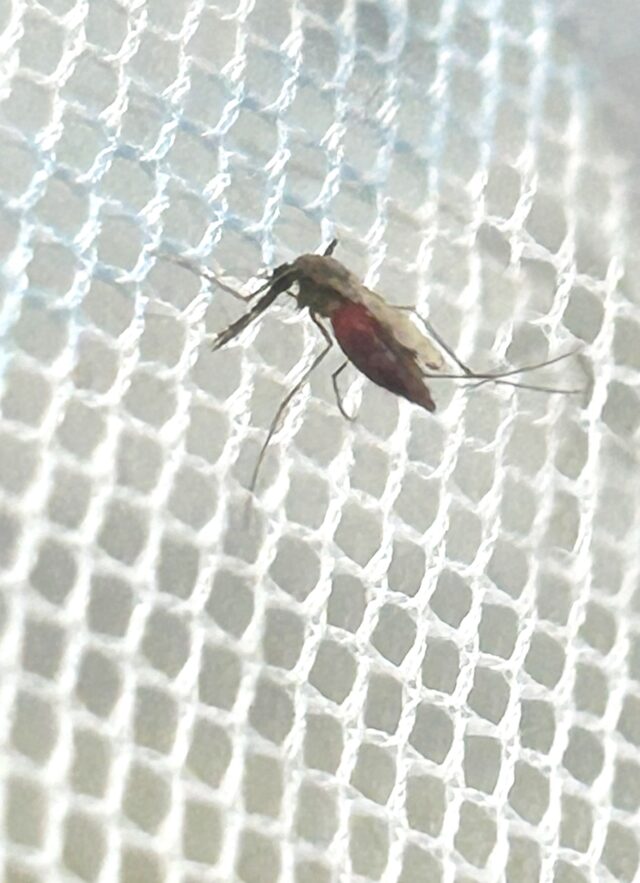
A malaria transmitting mosquito resting on insecticide-treated net because of its ability
to breakdown insecticides
This discovery provides great insight into the genetic basis of insecticide resistance, a challenge that has long hindered malaria control efforts. The team uncovered a single mutation in the mosquito gene CYP6P3 (E205D) that dramatically enhances the mosquito’s ability to break down pyrethroid insecticides, thereby reducing the effectiveness of standard bed nets. Crucially, the study also demonstrated that the CYP6P3-E205D variant combines together with the previously known mechanism (target-site resistance) to exacerbate the loss of bednet efficacy including PBO-based nets pointing to the need for control programmes to use dual active ingredients nets to better counteract current resistance levels.
The research overcame long-standing barriers in detecting metabolic resistance by using a hybrid strain strategy to separate genetic variants from resistance phenotypes. Through whole genome sequencing, functional validation assays, and extensive field studies, the scientists were able to elucidate the genetic implications of metabolic resistance and design simple, reliable DNA-based assays that can be deployed directly in the field. These assays allow malaria control programs to track the spread of resistance and assess its impact on interventions, providing a powerful tool for rational decision-making and timely resistance management.
Prof. Charles Wondji, Senior author said “Our study designed field-applicable tools to easily track the spread of metabolic resistance in the major malaria mosquito species and assess its impact on control interventions. These important findings can help to maintain the effectiveness of insecticide-based tools such as bednets which remain a cornerstone of malaria prevention.”
The study also revealed that the resistance mutation is spreading rapidly across West and Central Africa, with evidence of introgression into Anopheles coluzzii populations in Ghana. This finding underscores the urgency of monitoring resistance across species, as genetic exchange accelerates the spread of resistance and complicates malaria control strategies. This key study demonstrates how fundamental research can lead to practical tools that safeguard human health. By providing malaria control programs with reliable diagnostics to detect resistance early, the work paves the way for more effective interventions and helps ensure that insecticide-based tools remain a cornerstone of malaria prevention. The article is published in Science Translational Medicine: https://doi.org/10.1126/scitranslmed.ado6222