
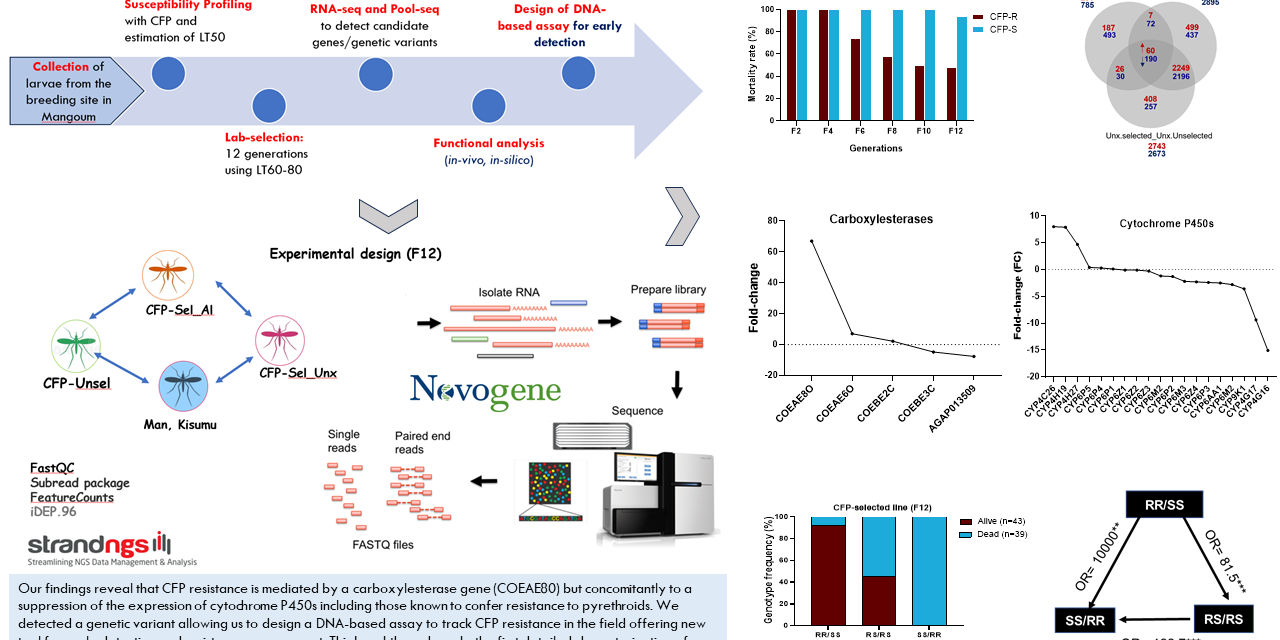
This study, led by Dr Magellan Tchouakui, a Wellcome Trust fellow at the Centre for Research in Infectious Diseases (CRID), investigates how mosquitoes transmitting malaria adapt to “chlorfenapyr”, a novel insecticide used in new generation bed nets. The team identified a gene called COEAE80 that helps mosquitoes survive chlorfenapyr, especially when detoxification gene families like cytochrome P450 are not overexpressed. This combination makes some mosquitoes less affected by the insecticide and therefore harder to kill.
Using this discovery, the researchers developed a simple DNA-based test that can detect chlorfenapyr-resistant mosquitoes early, allowing control programmes to adjust their strategies before nets lose effectiveness. Encouragingly, most mosquitoes in the study still carry gene profiles that remain vulnerable to current dual‑ingredient nets, so these tools are still working well for now.
“This is the first time chlorfenapyr resistance has been clearly described in malaria vectors,” says Dr Tchouakui. “It gives us a head start to protect this important insecticide and design smarter, more sustainable malaria control strategies.”
To learn more about the study and its implications, read the preprint publication preprint publication.