
Prof Charles Wondji, CRID’s Executive Director and Head of the LSTM Research Unit at CRID, will lead a team of experts to generate robust evidence to support the adoption of spatial repellents as a novel tool to reduce malaria burden in Africa.
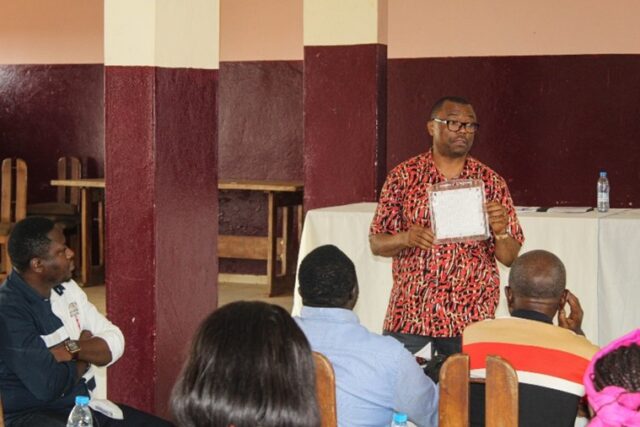
Prof Charles Wondji presenting a spatial repellent during a stakeholder engagement meeting in Ntui, Cameroon
Malaria prevention relies heavily on insecticide-based interventions, notably insecticide-treated nets. However, efforts to reduce malaria burden have stalled recently due to several challenges including insecticide resistance. Consequently, it is imperative to expand the toolbox for vector control to turn the tide and accelerate malaria elimination efforts. Among novel tools are spatial repellents which are small devices designed to be hung on walls indoors releasing an active ingredient into the air that kills mosquitoes or prevents them from biting and can provide effective protection for up to a year preventing disease transmission.
The Unitaid-funded project, Catalyzing the Adoption of a Novel Vector Control Toolbox (CANVeCT) will generate evidence to support WHO’s recommendation for the use of spatial repellents in combination with insecticide-treated nets, and will test its effectiveness as a standalone intervention. Professor Wondji said: “We are delighted to have been awarded this 5-year CANVeCT project by Unitaid to generate the evidence needed for an evolution of the recommendation by WHO on spatial repellents and to catalyze its adoption across Africa, in accordance with CRID’s motto which is Saving lives through quality research”.
CANVeCT will implement a randomized controlled trial in a region of Cameroon with high malaria transmission, historically low coverage and use of insecticide-treated nets, and elevated pyrethroid resistance to establish the level of protection that spatial repellents may provide if deployed in combination with insecticide-treated nets or on their own. The project will also conduct a household trial in humanitarian settings in Cameroon to establish operational parameters for optimal distribution mechanisms, address potential challenges, and identify barriers to entry and scale-up of affordable products.
Other key factors to be evaluated include social studies on compliance and acceptability, modelling to predict cost-effectiveness and likely impact on disease burden, community and civil society engagement activities as well as close collaboration with national malaria control programmes and international stakeholders to promote the adoption of spatial repellents.
CANVeCT will be led by CRID and implemented in collaboration with the Liverpool School of Tropical Medicine (LSTM) and the London School of Hygiene & Tropical Medicine (LSHTM) .
CANVeCT is funded by Unitaid to a total amount of US$18.1 million. Dr Philippe Duneton, Unitaid Executive Director said: “As malaria evolves, our tools to control it must evolve too. Spatial repellents are the newest vector control tool in decades, and through this investment, we aim to expand their use to offer greater protection to the most vulnerable people and communities.”
Notes to the editor
About CRID
The Centre for Research in Infectious Diseases (CRID) is a non-profit research centre established in 2018 that provides an excellent environment for conducting high-quality, internationally recognized research on infectious tropical diseases in Cameroon and across Africa. CRID’s vision is to improve living conditions by carrying out impactful research and enhancing the skills of researchers specializing in infectious tropical diseases, while its mission is to help fight these diseases in Africa through advancing knowledge and building research capacity in affected regions.
About Unitaid
Unitaid is a global health organization that saves lives by making new health products available and affordable for people in low- and middle-income countries. Unitaid works with partners to identify innovative treatments, tests and tools, help tackle the market barriers that are holding them back and get them to the people who need them most – fast. Since Unitaid was created in 2006, the organization has unlocked access to more than 100 groundbreaking health products to help address the world’s biggest health challenges, including HIV, TB and malaria; women’s and children’s health; and pandemic prevention, preparedness and response. Every year, more than 300 million people benefit from the products Unitaid has helped roll out. Unitaid is hosted by the World Health Organization.