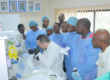

From October 30 to November 4, 2025, the Centre for Research in Infectious Diseases (CRID) hosted an intensive internal training session on the bCUBE system–a portable, field-adapted device designed for real-time malaria data collection.
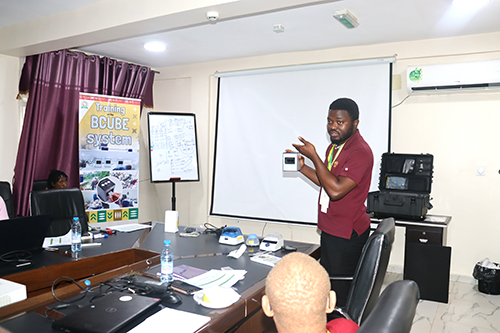
Charlin Dongmo, Biomedical engineer
Fifteen researchers participated in a bCUBE system training as part of phase 2 of the bCUBE project, funded by the Gates Foundation. This initiative builds on the success of phase 1, which demonstrated the feasibility of field-based PCR, and now aims to prepare CRID staff to support nationwide deployment of bCUBE across 25 health districts in Cameroon in collaboration with the National Malaria Control Program (NMCP).
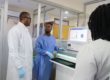
In his opening remarks, Principal Investigator Prof. Charles Wondji encouraged participants to fully engage in the sessions, stressing their key role in later training health district personnel. Over four days, the course combined theoretical modules with hands-on laboratory work and field testing. Participants reviewed qPCR principles, learned how to set up and operate the bCUBE platform and bAPP interface, and produced dry cartridges for genotyping knockdown resistance (kdr) markers and detecting Plasmodium infection.
A major highlight was the field deployment exercise in Elende village, where participants successfully tested the bCUBE system using mosquitoes collected on site and dry cartridges produced at CRID. This exercise confirmed the robustness and field-readiness of the platform, reinforcing its potential for decentralized, real-time diagnostics in operational settings.
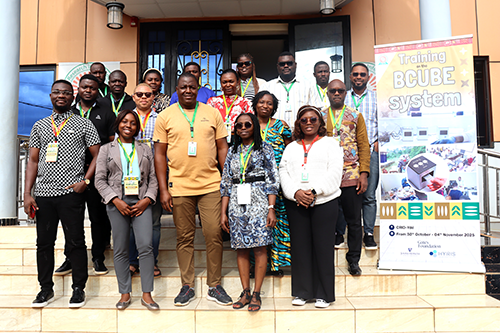
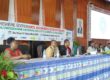
Family picture
Reflecting on the training, PhD candidate Brice Natchema noted that the team independently performed Plasmodium infection detection, kdr genotyping, and customized 36‑well dried cartridges, which were used in the field to deliver on-site results and bypass the need for centralized laboratories. Laboratory technician Nzembon Sonia emphasized that the training strengthened her ability to perform real-time PCR on a compact, cloud-connected system, from sample preparation to data interpretation via the Hyris platform, enhancing her readiness for emerging molecular technologies in research and diagnostics.
Led by Dr. Armel Tedjou, with support from Dr. Judith Labou, Wilfried Kombat and Charlin Dongmo, the training significantly strengthened CRID’s technical capacity and laid the groundwork for the upcoming national training phase planned for 2026.