
On Wednesday, September 17, 2025, CRID hosted a pivotal restitution meeting for the African Consortium in Modeling for Effective Vector Control (ACoMVeC) Operational Research Projects (ORPs).
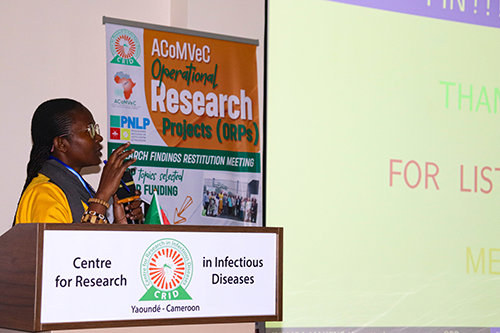
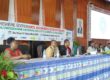
Dr. Djouda Bilyole presenting her analysis on the cost-effectiveness of IRS versus ITNs
Dr. Albert Zeh Meka, Permanent Secretary of the National Malaria Control Programme (NMCP), led a delegation of 14 experts to engage in a pivotal discussion of recent findings from four malaria modeling specialists. This meeting marked a milestone in Cameroon’s malaria fight, highlighting the shift from reliance on external modeling expertise to cultivating local talent. Thanks to intensive training at CRID, 16 PhD students have now specialized in malaria modeling, and this growing corps of experts is actively contributing to the NMCP’s strategic planning and decision-making. Local capacity in advanced modeling is now being harnessed to inform, strengthen, and shape Cameroon’s malaria control interventions.
During the opening session, Prof. Charles Wondji, Executive Director of CRID and Principal Investigator of ACoMVeC, expressed his appreciation: “The presence of the Permanent Secretary of the NMCP is a powerful testament to the spirit of collaboration we are building together. This project is a milestone in our journey to harness mathematical modeling as a strategic tool for designing more effective vector control programs. Through this initiative, we are equipping the NMCP with the capacity to understand, apply, and eventually lead in modeling-based decision-making”.
Highlights of the Research Findings
Professor Didjou-Demasse Ramses, Co-Principal Investigator of the project, chaired the Scientific Session, which showcased research from the ORP awardees. The session began with Dr. Djouda Sonkoue Bilyole presenting her analysis of the cost-effectiveness of Indoor Residual Spraying (IRS) versus Insecticide-Treated Nets (ITNs), taking into account how insecticide resistance can be influenced by temperature variability. Based on her findings, Dr. Sonkoue Bilyole advocated for a multi-pronged intervention strategy, emphasizing that local decisions should be informed by available resources, historical patterns of resistance, and disease prevalence. Her work highlighted IRS as an effective alternative for malaria control under certain conditions.
Ms. Wamba Laura presented her research on the risk of emergence of resistance to Artemisinin-based Combination Therapies (ACTs) in Cameroon. Her study examined how factors such as patient adherence to treatment, drug efficacy, and community immunity influence the spread of malaria. She emphasized the urgent need for large-scale sensitization campaigns to improve treatment adherence, the enhancement of diagnostic tools capable of detecting asymptomatic infections, and targeted interventions to bolster community immunity. These recommendations aim to delay or prevent the development and spread of ACT resistance, safeguarding the continued effectiveness of this cornerstone malaria treatment.
Dr. Kamgang Jean-Claude presented his study on the nationwide distribution of a single type of Long-Lasting Insecticidal Nets (LLINs), focusing specifically on pyrethroid-piperonyl butoxide (PBO) nets and their role in reducing malaria transmission and mortality. His findings indicated that expanding coverage of PBO nets could substantially lower disease prevalence, especially in regions like Adamawa. In such areas, combining different net types or integrating other control methods may be necessary to maximize impact.
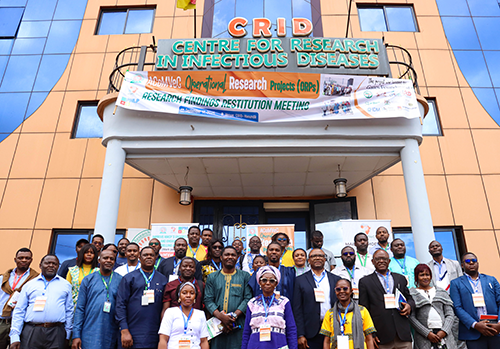
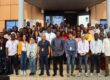
Family picture
The session concluded with Professor Fotsa-Mbogne David Jaurès’ presentation examining how patterns of LLIN usage affect malaria transmission dynamics. He highlighted the importance of increasing LLIN coverage and advocated exploring complementary strategies, such as Indoor Residual Spraying (IRS) with newer long-lasting insecticides like Tenebenal, to overcome operational challenges and enhance vector control efforts.
Strengthening Collaboration for Malaria Elimination
In his closing remarks, Dr. Zeh Meka praised the high quality of the research and its alignment with the NMCP’s strategic priorities. He acknowledged the emergence of local expertise and reaffirmed the NMCP’s commitment to involving the ORP awardees in departmental initiatives where their contributions could be most impactful.